
The 34-page report that changed nothing. (And the memo that did.)
Two weeks after the event, someone asks what we're going to change for the next edition. And the room goes quiet. The answer isn't a longer report — it's three one-page memos.
There's a moment that repeats itself at almost every event. It doesn't happen during. It happens right after.
Two weeks later. The wrap-up meeting. A room full of tired people. Someone opens the PDF. Photos, agenda, NPS, "it all went great." And then someone asks the only question that matters:
"Right. So what are we changing for next year?"
Silence.
Not for lack of work. The report ran to 34 pages. There was plenty of work in it. The problem was something else: nobody knew what decision to make with any of it.
I've been watching this for a while now. And every time I ask myself the same thing: how many budgets have been cut not because the event was bad, but because nobody could explain what was going to improve?
Your report isn't competing on completeness. It's competing on usefulness.
Leadership doesn't buy documentation. It buys learning. What your CFO — and your CMO — want to hear isn't "people were happy." That's an outcome, not an argument. What they need is this:
"We made these three decisions, and this is the impact we expect because of them."
Because next year's budget gets approved on one very simple question: what are we going to do better, and how do we know?
If your report doesn't answer that, the event stays filed as a cost. Not as an investment.
The root error: confusing a report with a recap
Most post-event reports tell you what happened. They read like a chronicle. But a report that's useful to leadership isn't a chronicle. It's a decision-making document.
The difference:
What the typical recap says:
- "The opening had good energy"
- "The afternoon block ran a bit long"
- "The closing was fine"
What a decision needs:
- "The opening stays as is: attention held for the first 18 minutes"
- "The post-lunch block gets redesigned: shorter, different format, scripted transitions"
- "The closing stops being a goodbye and becomes an activation moment"
It isn't more work. It's a different approach — and that approach starts before the event, not after it.
The fix: 3 Decision Memos. One page each.
A Decision Memo is one page with one single decision. A good post-event debrief doesn't have a long report. It has three memos.
Template — copy and paste:
- Decision (one sentence)
- What we observed (one data point or one signal)
- What it means (interpretation, not description)
- Proposed change (a concrete action, with an owner)
- Expected impact (what improves, and how I'll see it)
- Risk accepted (what could go wrong)
- What I need from leadership (approval / budget / timing)
One rule: if a decision doesn't fit on a single page, it isn't clear yet.
3 real memos — no names, just the pattern
These three show up almost every time you measure the real experience of an event. Not stated satisfaction. Real experience.
Memo 1 — The post-lunch block
Decision: redesign the afternoon block to win attention back.
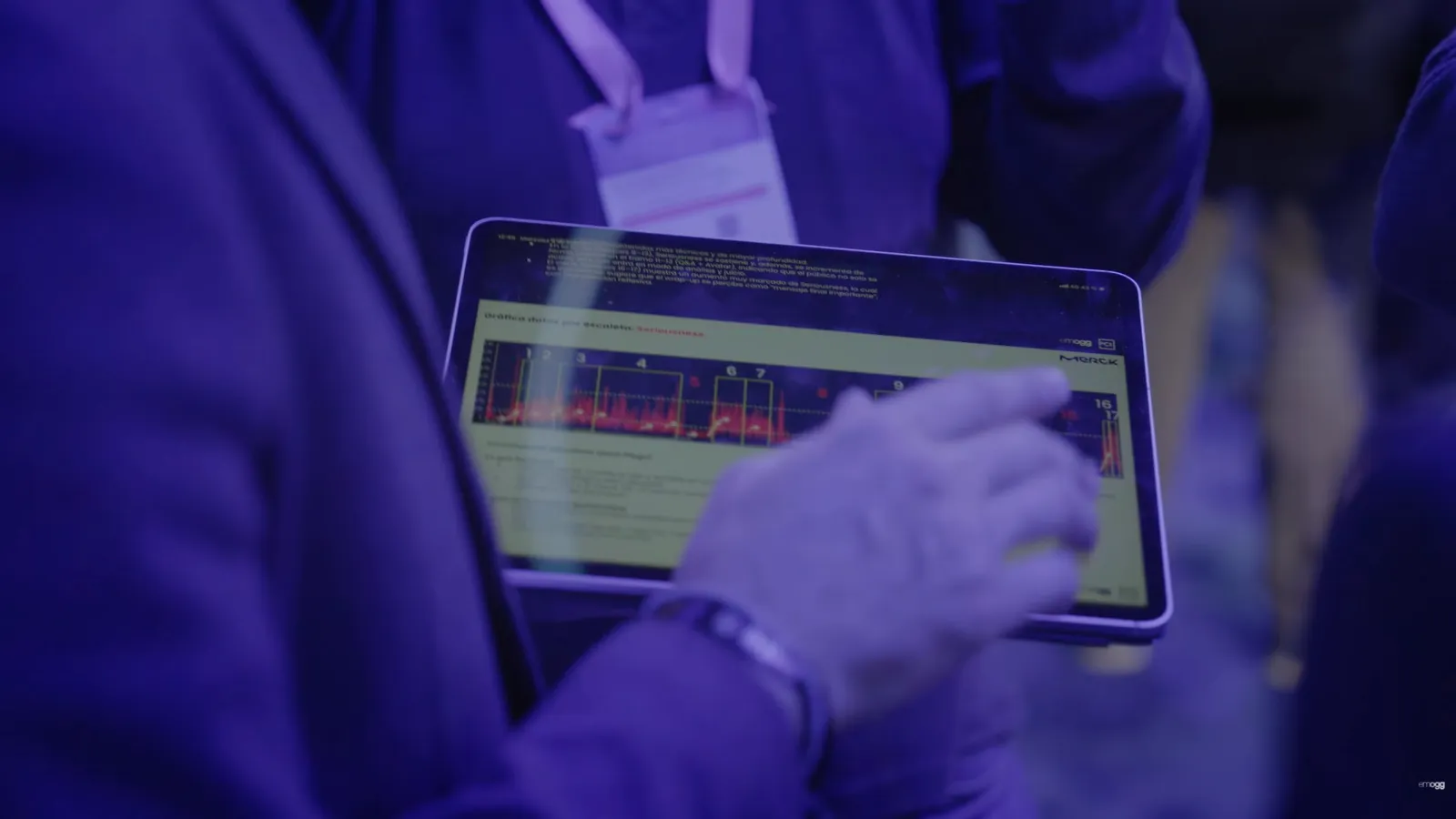
What we observed: a sustained drop from minute 8-12 onwards. Micro-spikes of disengagement at every speaker change. Partial recovery whenever there's interaction.
What it means: the content isn't bad. It's physiology plus format. The human body doesn't work the same way at 4pm as it does at 10am — and the programme doesn't account for that.
Proposed change — 4 levers:
- Cut the length: fewer minutes, more density
- Alternate formats: talk → activity → case study → Q&A
- Script the transitions: kill the "and now we'll hand over to..."
- Energy reset: 90 seconds of something physical or participatory before the next block
Expected impact: less silent disengagement. Better retention of the key message.
Memo 2 — Transitions (the invisible friction)
Decision: treat every transition as part of the design, not as filler.
What we observed: every speaker change produces a drop. The technical setup breaks the rhythm before the content even starts.
What it means: the event doesn't lose points on content. It loses them on the glue. Quality is built as much in the transitions as in the main programme.
Proposed change:
- A 20-30 second transition script: what's coming and why it matters
- A "rhythm owner": someone accountable for the event not sagging between blocks
Expected impact: less perceived friction, more sense of flow.
Memo 3 — The closing
Decision: redesign the closing as an activation moment, not a farewell.
What we observed: the ending arrives with accumulated fatigue. "They loved it" — but it generates no follow-up action.
What it means: a good event without a closing is good spending. But a poor asset. What the attendee remembers is disproportionately the last 10 minutes.
Proposed change:
- Close with 1 idea + 1 decision + 1 action for the next 48 hours
- A closing ritual: have the attendee do something before they leave — commit, vote, answer a question out loud
Expected impact: stronger recall, more conversation afterwards, more real activation.
Before you open PowerPoint, ask yourself this
Which three decisions can I put forward with evidence behind them?
If you can't answer that, you're measuring satisfaction. You're not measuring experience.
Next time you wrap an event, start here. Copy these seven lines into a doc — or into the closing email to your team — and fill them in. It takes 10 minutes.
Decision:
What we observed:
What it means:
Proposed change:
Expected impact:
Risk accepted:
What I need from leadership:
Write three memos. That's a post-event debrief leadership approves.
P.S. If your report doesn't contain decisions, it isn't a report. It's a file.
One question before I go:
What's hardest for you to defend to leadership after an event: the budget, the format, the speaker line-up or the value of networking? Reply here or send me a message.
This piece was originally published in Emotional ROI · The MICE Pulse, Emogg Analytics' monthly newsletter on experience measurement at events. Subscribe to get the next issue.